
~*~ BEHIND THE FX ~*~
How ILM and Stan Winston Changed Movies FOREVER
| [HOME] | | | [DINO GUIDE] | | | [BEHIND THE FX] | | | [LOST WORLD REVIEW] | | | [GUESTBOOK] |
|
OK fellow movie nerds, buckle up because this is my FAVORITE topic to talk about. How they made Jurassic Park is one of the most amazing stories in filmmaking history. When Spielberg set out to make this movie in 1991, he originally planned to use stop-motion animation (like in the old Ray Harryhausen movies) with go-motion improvements. Phil Tippett was hired to do it all. Then something INCREDIBLE happened. Dennis Muren and his team at Industrial Light and Magic (ILM) showed Spielberg a test of a computer-generated T-Rex skeleton walking across a screen. Spielberg was blown away. Phil Tippett reportedly said "I think I'm extinct" and Spielberg loved that line so much he PUT IT IN THE MOVIE (Ian Malcolm says it). What followed was a revolutionary combination of TWO groundbreaking approaches that made the most realistic dinosaurs anyone had ever seen on screen. |
|
The CG Revolution |
 THE TEAM:
Dennis Muren (VFX Supervisor), Steve "Spaz" Williams, Mark Dippe, Eric Armstrong, and the incredible artists at ILM's CG department. THE TECH:
|
|
Practical Magic - The Animatronics |
||||||||||||||||||||||||
|
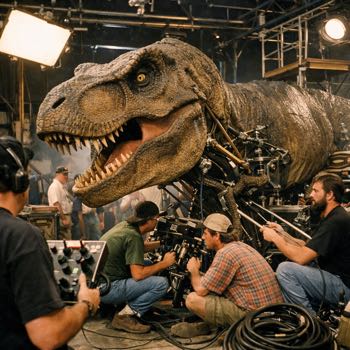
THE MAN, THE LEGEND: Stan Winston was already the GOAT of practical effects before JP. He did the Terminator endoskeleton, the Alien Queen, Predator... the man was a GENIUS. For Jurassic Park, he and his team built full-size animatronic dinosaurs that are, to this day, the most incredible practical effects ever created. THE BUILDS:
THE FULL-SIZE T-REX: This is the crown jewel. Stan Winston's team built a FULL-SIZE T-REX animatronic. It was powered by hydraulics, controlled by a combination of puppeteers and a telemetry rig. The skin was made of foam latex over a steel skeleton. When it rained during the T-Rex breakout scene filming, the foam latex absorbed water and the Rex became even HEAVIER. The crew reported it would start shaking and moving on its own because of the extra weight. TERRIFYING. Imagine being on set with a 9,000-lb robot dinosaur that starts moving by itself!! THE RAPTOR SUITS: Real humans in raptor suits!!! Performers (including John Rosengrant, one of Winston's top guys) wore full-body raptor costumes for many of the shots. The heads were cable-controlled for the eye movements and lip snarling. This is why the raptors feel so REAL - there's an actual person inside giving them weight and movement and intention. The kitchen scene uses a combination of these suits and CG, and you literally CANNOT TELL which is which. MIKE'S MIND-BLOWN MOMENT: The T-Rex in the rain. That shot where it crashes through the Plexiglas roof of the Ford Explorer and the glass is supposed to break but it was TOO STRONG so it started crushing the car for real, and the kids' screams are 100% genuine because they thought they were going to die. ACTUAL TERROR captured on film. Spielberg kept the take. That is filmmaking, baby. |
|
CG + Practical = PERFECTION |
|
Here's why Jurassic Park's effects STILL hold up in 1997, four years later, and will hold up for decades to come. It's the COMBINATION. THE RULE: Close-ups = animatronics. Wide shots and full-body movements = CG. This meant you always had REAL PHYSICAL WEIGHT in the close-ups (because it IS a real physical thing) and you got impossible camera movements and full-body action in the wide shots. EXAMPLES:
Spielberg understood something that many directors today forget: the best special effect is the one you can't tell is a special effect. |

|
The Lost World (1997) pushed everything even further:
|
|
(I memorized all of this and I'm not sorry) JP (1993): ~50 CG shots, ~6 min CG screen time, 18 months CG work TLW (1997): ~90 CG shots, ~10 min CG screen time, ILM's biggest project at the time Hardware (1993): SGI Onyx, Indigo2 workstations Hardware (1997): SGI Origin 2000 servers Software: Alias PowerAnimator, ILM proprietary tools T-Rex animatronic weight: 9,000 lbs / 4.5 tons Total dinosaur animatronics built for JP: 6 full-size + numerous parts Stan Winston Studio crew size: ~40 artists and technicians Academy Awards won for JP VFX: YES (1994 Best Visual Effects) |
 mikejpfan@aol.com